
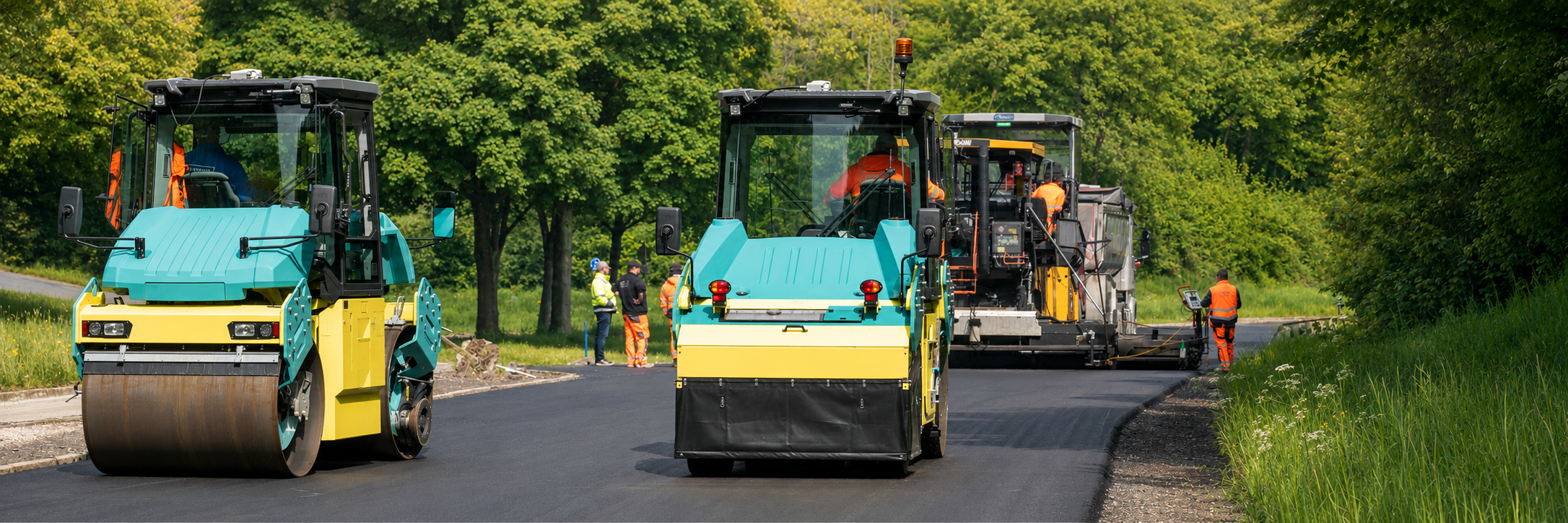
Warm-mix asphalt, also known as WMA, is currently changing more than construction methods. It is reshaping the requirements for asphalt construction as a whole.
While discussions often focus on asphalt mixes, additives, or production methods, practical experience shows that the change goes much further. Above all, it affects how construction processes are organized.
The key question is increasingly how paving processes can be planned, managed, and documented reliably under changing conditions. As temperatures decrease, not only technical parameters change. Requirements for planning, logistics, and execution also become more demanding.
A Europe-wide development as a common framework
This development is not limited to individual countries. Across Europe, temperature-reduced asphalt construction methods are gaining importance.
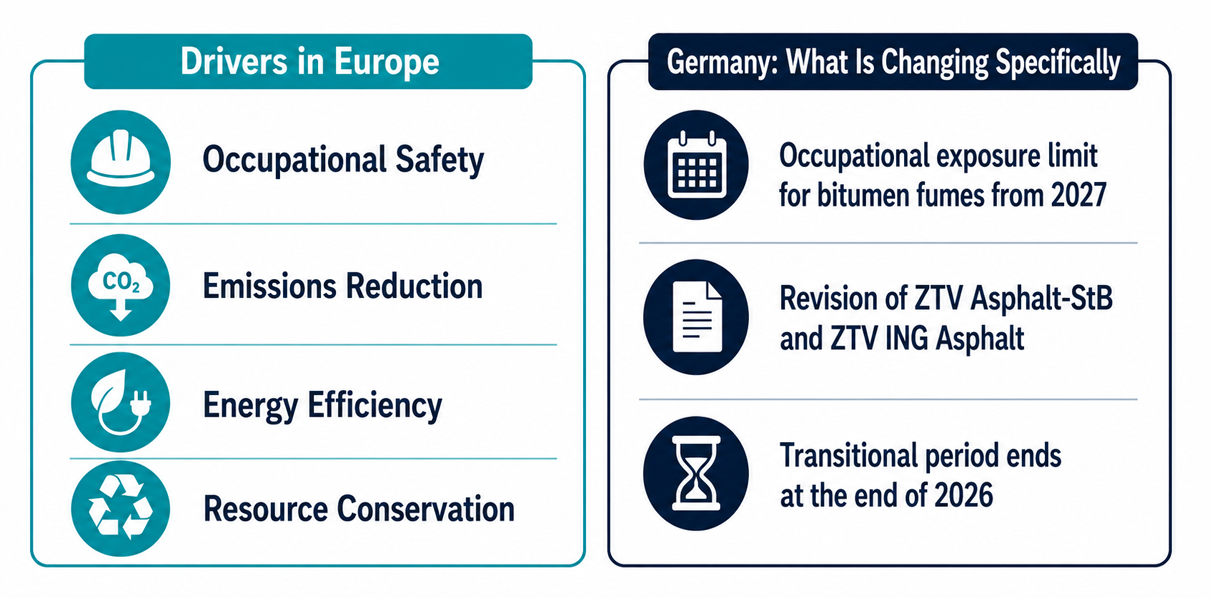
The main drivers are largely the same: stricter occupational safety requirements, political targets for reducing emissions, and a growing focus on energy efficiency and resource conservation.
While Germany is strongly driven by regulatory limit values, other countries rely more on technical guidelines or industry-led standards. Organizations such as the European Asphalt Pavement Association help to consolidate experience and make it available across national borders.
As a result, a shared European framework is emerging, within which requirements are gradually becoming more aligned. Warm-mix asphalt is therefore developing from an optional solution into an increasingly expected standard, often in combination with recycling methods.
Germany: regulatory requirements are becoming more concrete
In Germany, this development is becoming particularly concrete.
With the binding occupational exposure limit for fumes and aerosols from bitumen coming into force in 2027, a clearly defined framework for action is being created. At the same time, key technical regulations are being revised, including ZTV Asphalt-StB and ZTV ING Asphalt. The suspension period ends at the end of 2026.
These developments mean that temperature-reduced asphalt construction methods can no longer be treated as a special case in the future. Instead, they will become an integral part of regular construction practice.
For construction companies, this creates the need to systematically adapt existing workflows, not only in production, but across the entire process chain
Changing requirements during paving
The introduction of temperature-reduced asphalt construction methods noticeably changes the conditions during paving.
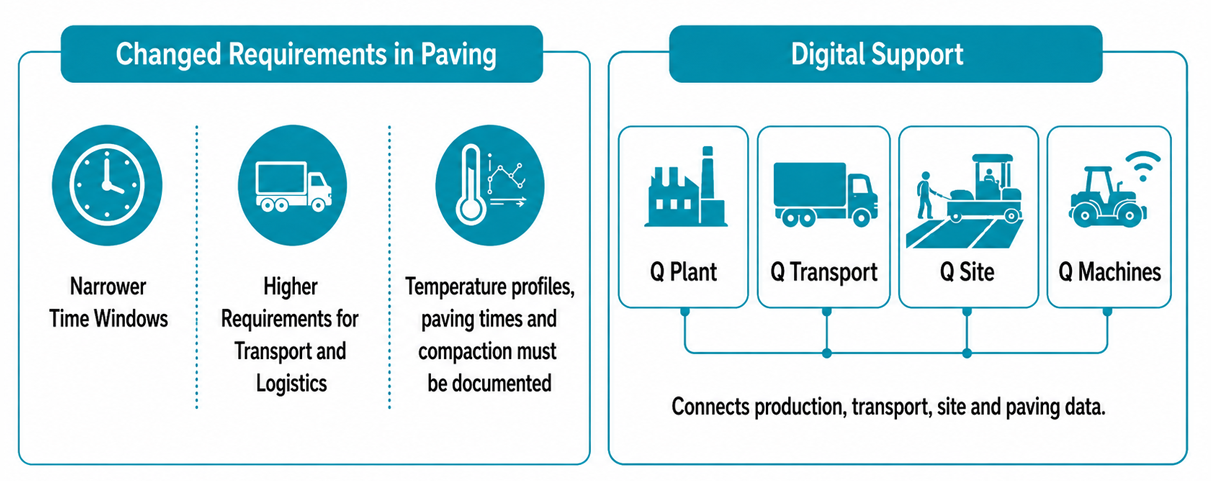
Lower processing temperatures lead to narrower time windows in which paving and compaction must take place. At the same time, the dependence on stable transport processes increases, as delays can have a direct impact on material properties.
Traceability and reproducibility are also becoming more important. Temperature trends, paving times, and compaction processes increasingly need to be recorded and documented systematically.
Quality is therefore no longer viewed only as a final result. It is increasingly understood as the outcome of a controlled and traceable process.
Companies that do not have this process chain under control will find it difficult to meet the requirements of the coming years.
Process integration as the central challenge
Against this background, the focus in asphalt construction is shifting.
While individual process steps were often considered separately in the past, their interaction is now becoming increasingly important.
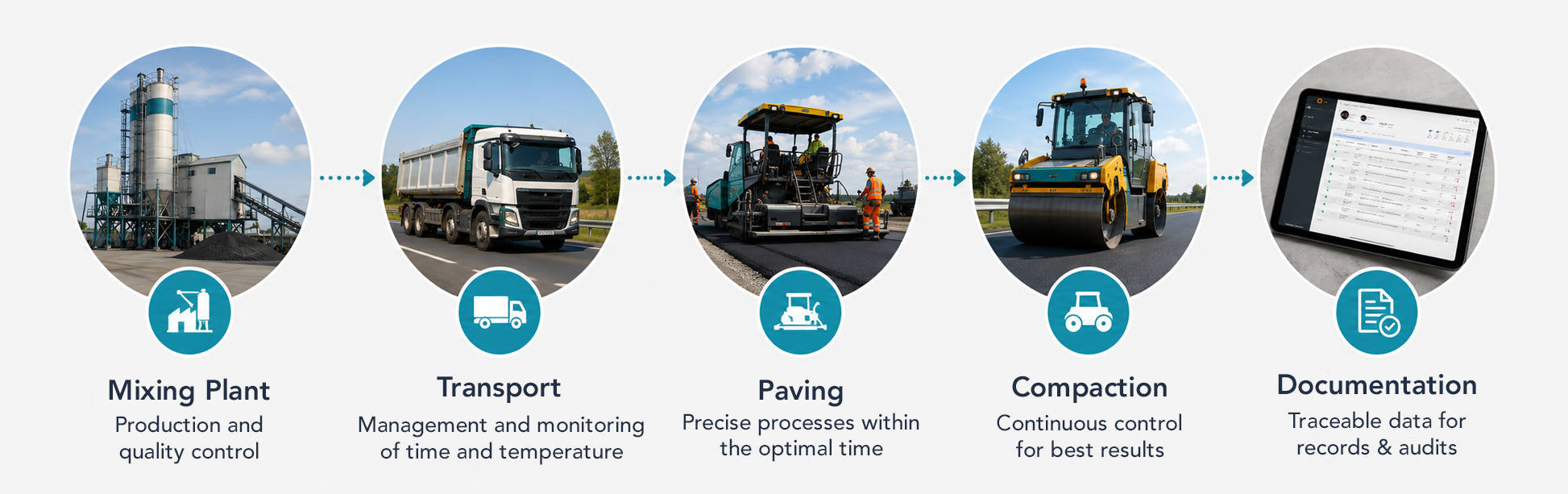
Production, transport, and paving are closely connected. Changes in one area have a direct impact on the processes that follow. This creates new requirements for coordination, control, and process management.
The challenge is therefore less about individual technical solutions. It is more about the ability to view and organize the entire process chain as one connected system.
The operational perspective
For construction companies, this development primarily means a change in how projects are planned and implemented.
Processes need to be better coordinated and, at the same time, made more transparent.
This is not only about complying with regulatory requirements. It is also about creating stable construction processes. The narrower the process windows become, the more important it is to plan workflows reliably and identify deviations at an early stage.
Companies that address these requirements early create the foundation for a controlled implementation of temperature-reduced asphalt construction methods. At the same time, they reduce operational uncertainty.
Digital support as a connecting element
In this context, digital solutions are becoming increasingly important.
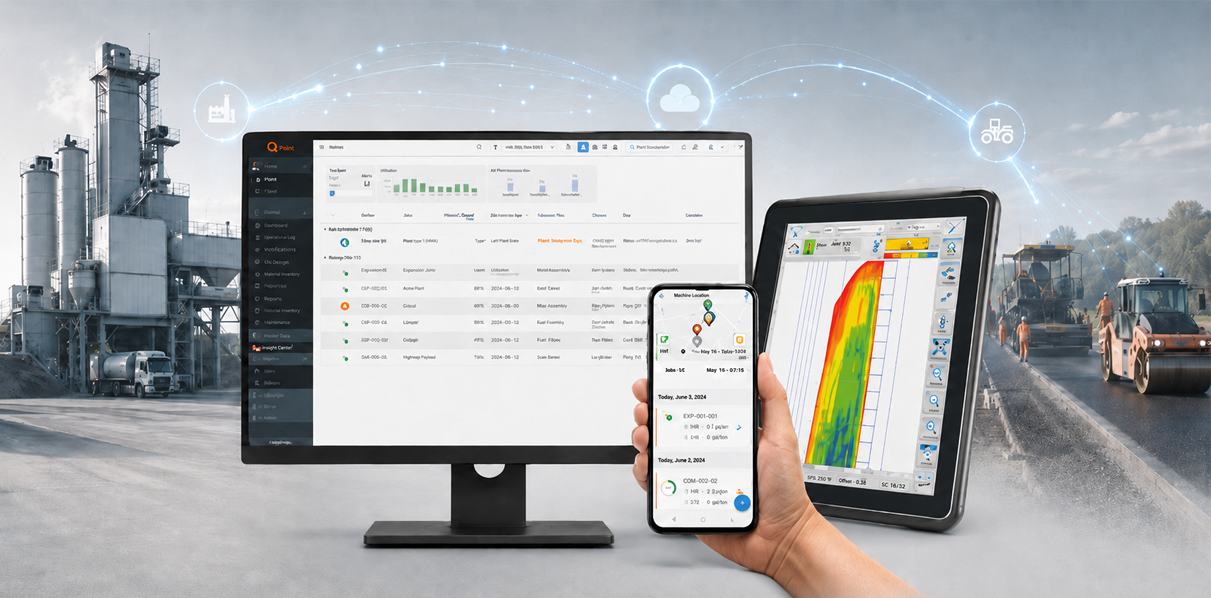
They make it possible to connect the different process steps and represent them in a shared system.
Q Point’s solutions address exactly this interface. Production data from the mixing plant is combined with information from transport and the construction site, then supplemented with data from paving and compaction.
Q Plant creates the connection to production. Q Transport maps logistics processes. Q Site supports planning and coordination on the construction site and connects ordering and delivery processes with execution. Q Machines adds quality-relevant data directly from the paving and compaction process.
This creates transparency and provides the basis for active process control. Workflows become traceable, deviations can be identified and assessed at an early stage, and documentation requirements can be fulfilled systematically.
Conclusion: from material focus to process perspective
Warm-mix asphalt is a clear example of a development in asphalt construction where technical innovation leads to organizational change.
The focus is no longer only on the material. What matters just as much is the ability to view and manage processes holistically.
Requirements from occupational safety, regulations, and practical construction processes are becoming increasingly interconnected. This makes an end-to-end process view essential.
These changes do not only affect paving. They already begin with production at the mixing plant. Lower production temperatures increase the requirements for production planning and process stability.
At the same time, they offer the potential to reduce energy consumption, production costs, and emissions. However, this can only be achieved if production, transport, and paving are precisely coordinated.
As a result, the focus in asphalt construction is shifting in the long term: away from individual measures and toward an integrated understanding of the entire process chain.