
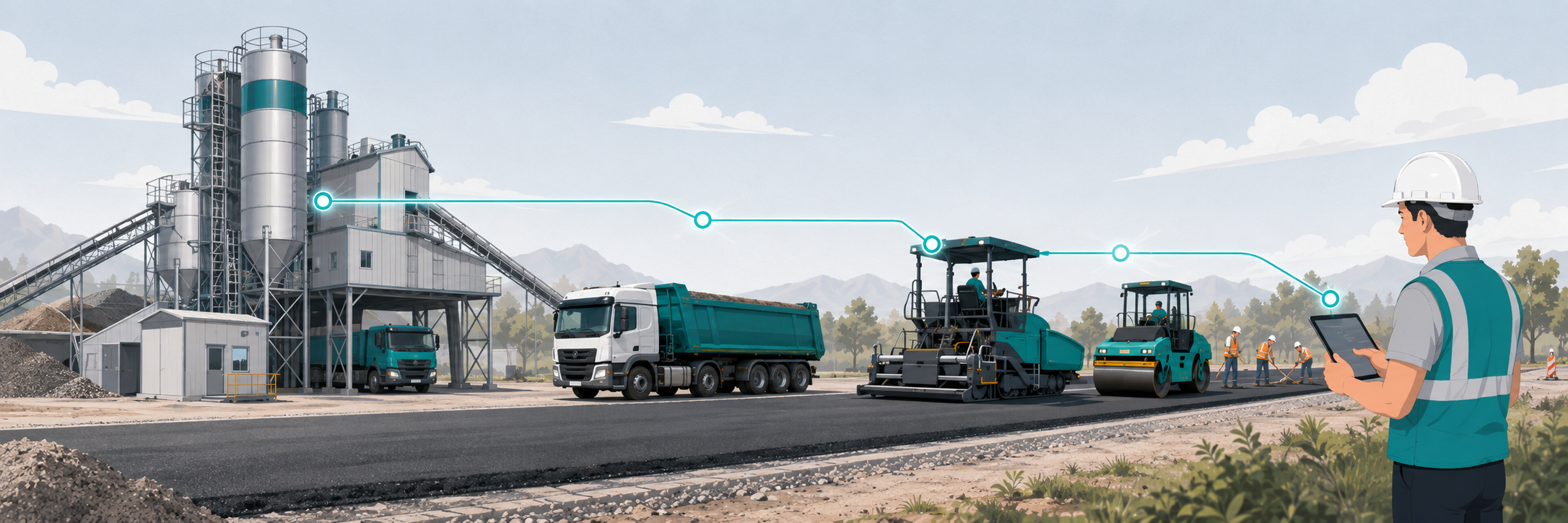
In asphalt construction, the success of a project rarely depends on a single step. What really matters is how well all parties work together throughout the day: the asphalt plant, dispatch, site management, foremen, drivers, paving crews and external partners.
They are all working on the same project. Yet in day-to-day operations, they often work with different levels of information. The jobsite plans the paving work and needs reliable delivery information. The asphalt plant needs to know what has to be produced and when. Dispatch coordinates vehicles, quantities and time slots. Drivers need clear instructions. And in the end, everything has to be documented properly: quantities, delivery tickets, temperatures, paving locations, photos and quality evidence.
When this information is spread across phone calls, emails, paper, messaging apps and different systems, gaps appear. Not because people are doing a poor job, but because the process involves too many handovers. This is exactly where Q Plant and Q Site come in: they connect the asphalt plant and the jobsite into one shared workflow.
With Release 2026.I1, both solutions move even closer together. The exchange of information between plant and jobsite has been expanded, orders can be transferred more completely with attachments, delivery quantities are assigned more clearly, and feedback from the jobsite arrives at the plant in a traceable way. You can find all details in the current release notes.
With the 2026.I1 release, both solutions move even closer together. The exchange of information between the asphalt plant and the jobsite has been expanded, orders can now be submitted more completely with attachments, delivery quantities are assigned more accurately, and feedback from the jobsite arrives at the asphalt plant in a clear and traceable way. You can find all the details in the latest release notes.
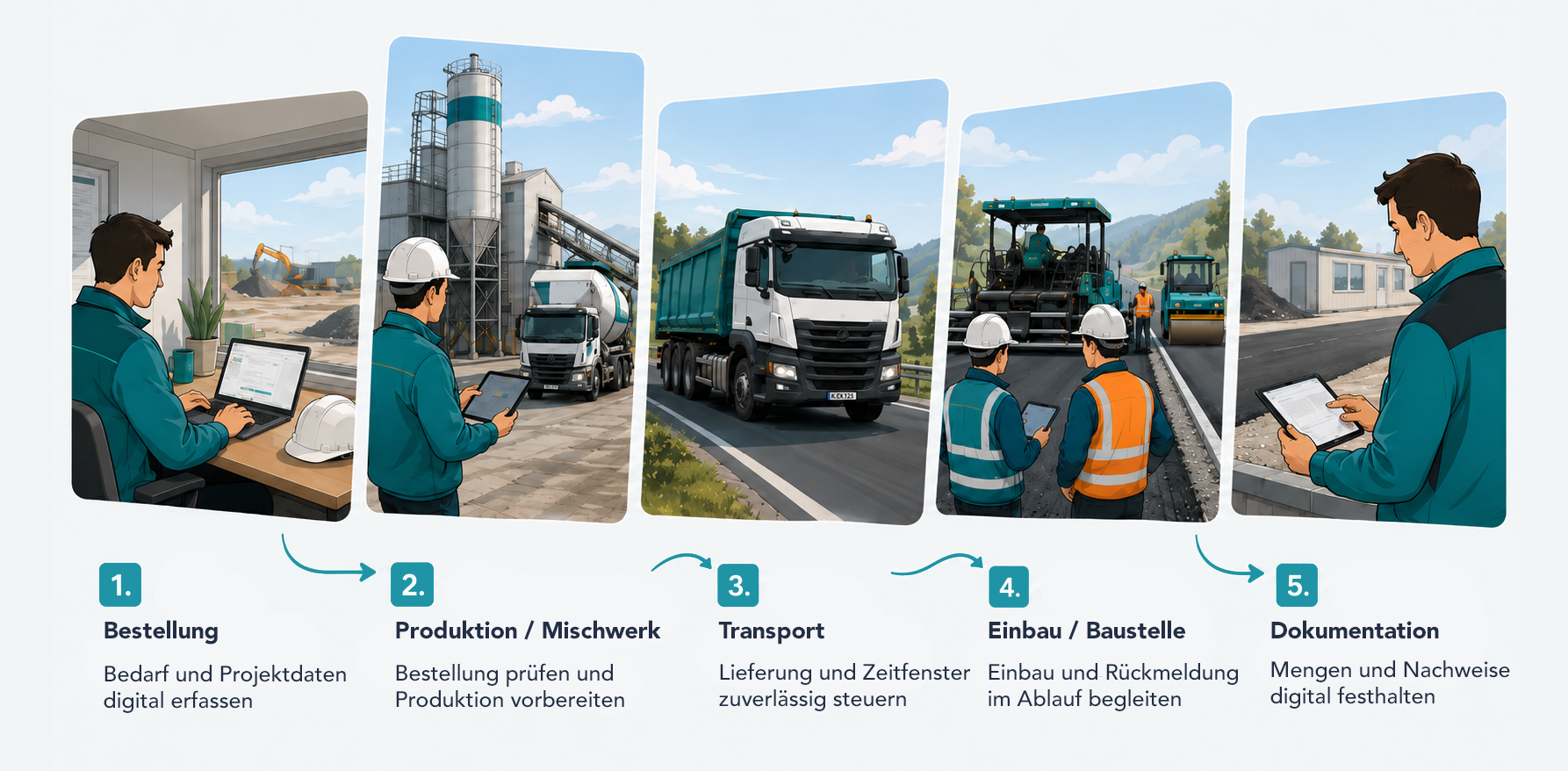
Two Sides of the Same Process
Q Plant supports the asphalt plant. It brings together information around orders, production, deliveries, delivery tickets, status updates, customer orders and, depending on the integration, data from plant control systems, weighing systems or other connected systems.
Q Site supports the jobsite. Construction companies, site managers and foremen can plan projects, order material, track deliveries, coordinate resources and document paving work. Each solution is valuable on its own. But the greater benefit comes when they work together.
In asphalt construction, the plant and the jobsite depend heavily on each other. The material is produced at the plant and placed on the jobsite. But for a paving day to run smoothly, everything before, in between and after also has to fit together: planning, ordering, production preparation, loading, transport, unloading, paving and documentation.
In this interaction, many small issues can arise in daily operations that may later have a major impact: a changed order quantity, a delayed delivery, a missing delivery ticket, an unclear unloading point, a truck arriving out of sequence or a temperature issue that is noticed too late.
When the asphalt plant and jobsite are connected, these issues become visible earlier. And what becomes visible earlier can be managed better.
Orders That No Longer Require Follow-Up Calls
A clean ordering process is the foundation for everything that follows. Orders can be entered digitally and transferred to the asphalt plant in a structured way. There, they are not just loose pieces of information, but available in the right context: with quantities, asphalt mix types, delivery times, additional details and relevant documents.
This reduces manual data entry and typical sources of error. Nobody has to piece together information from emails, phone notes or chat messages. What was ordered is clear and traceable for both sides.
This is especially important when changes occur. Things change on jobsites. That is normal. What matters is that changes arrive clearly and do not get lost somewhere between the jobsite, dispatch and the plant. When changes are visible digitally, teams can respond faster.
Attachments also play an important role. Plans, photos, contract documents or other project files can be attached directly to orders. This keeps important information exactly where it is needed: with the order itself. That may sound simple, but in daily operations it saves exactly the time that would otherwise be lost searching, asking and forwarding.

More Stability in Deliveries
Between the asphalt plant and the jobsite lies logistics. And this is often where the difference is made between a calm paving day and a hectic one.
When delivery information, vehicles and drivers are digitally connected, both sides gain a clearer picture of the current situation. The jobsite can see which material is on the way and when it is expected to arrive. The asphalt plant receives feedback on what is happening out in the field.
Unloading, acceptance or rejection of delivery tickets can be reported back and supplemented with photos or comments. This turns a delivery from a simple transport step into a traceable part of the process.
For paving, this is critical. Asphalt work depends on rhythm. If material arrives too early, waiting times occur. If it arrives too late, paving may be interrupted. If nobody knows where the trucks are, teams have to improvise. A better connection between plant, transport and jobsite helps maintain that rhythm.
Production Closer to Reality
A plan is important. But the paving day does not always follow the plan. Weather, traffic, equipment, personnel, site conditions or delays can change the workflow. That is why it is not enough to know only the original order. The asphalt plant needs the most up-to-date information possible on how the paving work is actually progressing.
When truck unloading, material flow and delivery status are reported back, the asphalt plant can plan ahead more effectively. Production can be better aligned with actual demand.
This helps not only the plant, but also the jobsite. The better production, transport and paving are coordinated, the lower the risk of unnecessary waiting times, oversupply or gaps in the material flow.
Documentation That Is Created During the Process
Documentation often becomes difficult when it is created after the fact. Delivery tickets then have to be found, quantities checked, photos assigned, temperatures added and comments reconstructed. This takes time and is prone to errors.
It is much better when documentation is created directly during the workflow. Digital delivery tickets can be provided and archived. Quantities remain traceable. Photos, comments and proof of delivery can be documented directly in connection with the delivery ticket. Temperature information can also be transferred from the asphalt plant to the jobsite and used there for quality assurance.
This makes documentation more complete and more credible because it is created closer to the actual event. For construction companies, this is particularly valuable when they need to provide clear evidence to clients of what was delivered, accepted and paved, and when. For asphalt plants, it also creates clarity because feedback from the jobsite does not get lost, but remains visible.

Quality Begins Before Paving
In asphalt construction, quality becomes visible at the end on the road. But it is created along the entire process chain. This includes the right order, the correct asphalt mix, coordinated delivery timing, reliable temperature management, clear communication and clean documentation.
Temperature is one example. If the loading temperature is recorded at the asphalt plant and transferred to the jobsite, the paving crew can assess earlier whether special attention is needed during placement. If a minimum delivery temperature is also defined, critical situations become more visible.
EPD data also belongs in this context. Environmental information and emission values are becoming increasingly important, not only for tenders, but also for documentation and communication with clients. If this information is available directly with the asphalt mix type, it does not have to be gathered manually later. In this way, quality is not understood as a single checkpoint, but as the result of a better connected process.
Do Not Forget the Drivers
Many digital processes focus on the office, the plant and the jobsite. Drivers are often overlooked. Yet they are a crucial part of the chain. Drivers need clear information: which order, which material, which jobsite, which route and which site-specific instructions.
When transport orders are provided digitally and important information such as points of interest reaches the driver directly, work on site becomes easier. This reduces follow-up questions, improves orientation and can speed up workflows on the jobsite. Especially on complex projects, it is not enough for information simply to exist. It has to reach the right person before it is needed.
What Is the Cost of Doing Nothing?
When new software is discussed, the conversation quickly turns to costs. That is understandable. But at least as important is the question: What does it cost to leave the existing process unchanged?
This cost of inaction is often not immediately visible in asphalt construction. It rarely appears as a separate line item in a calculation. But it is felt every day. It comes from follow-up questions, duplicate data entry, manual corrections, unclear delivery status, waiting times, missing documents, time spent searching and misunderstandings. It becomes especially costly when, after paving, it is unclear what was actually ordered, delivered, accepted or documented — and small uncertainties turn into later clarifications or disputes.
One phone call is not a problem. One email is not a problem either. But across many projects, many deliveries and many stakeholders, these small points of friction add up. On top of that come risks that are harder to quantify: interrupted paving, missing evidence, unclear responsibilities or decisions based on outdated information.
The cost of inaction describes the price companies pay when the asphalt plant and jobsite continue to work with too many disconnected information channels.

Where Does the Value Come From?
Return on investment does not come from a single module. It comes from the sum of many everyday improvements: orders arrive more clearly, changes are traceable, deliveries become more visible, unloading and material flow are reported back, documentation is created closer to the process, drivers are better informed and quality evidence becomes easier to provide.
The result is not only time savings. It is a more stable workflow. And that is highly valuable in everyday construction: less stress, fewer follow-up calls, fewer manual corrections and greater clarity for everyone involved.
That is why ROI is not reflected only in minutes saved, but also in better planning reliability, more secure quality and more professional collaboration between plant, jobsite and transport.
What Changes in Daily Operations
In the end, this is not about digitising individual tasks. It is about better connecting two areas that already depend on each other in asphalt construction.
The asphalt plant can only produce and dispatch effectively if it knows what the jobsite needs. The jobsite can only pave effectively if material, delivery information and quality evidence are reliably available.
When both sides work with the same up-to-date information, the entire process becomes calmer and more traceable. For asphalt plants, this means greater transparency, better control and stronger customer service. For construction companies, it means better planning, less time spent searching and greater confidence during paving. For clients, it means more transparent workflows and cleaner documentation.
And for everyone together, it means this: the asphalt process does not become more complicated. It becomes easier to understand.
Because good digital processes are not recognised by how loud they are. They are recognised by how much easier they make everyday work.